Kembali ke BlogCoffee 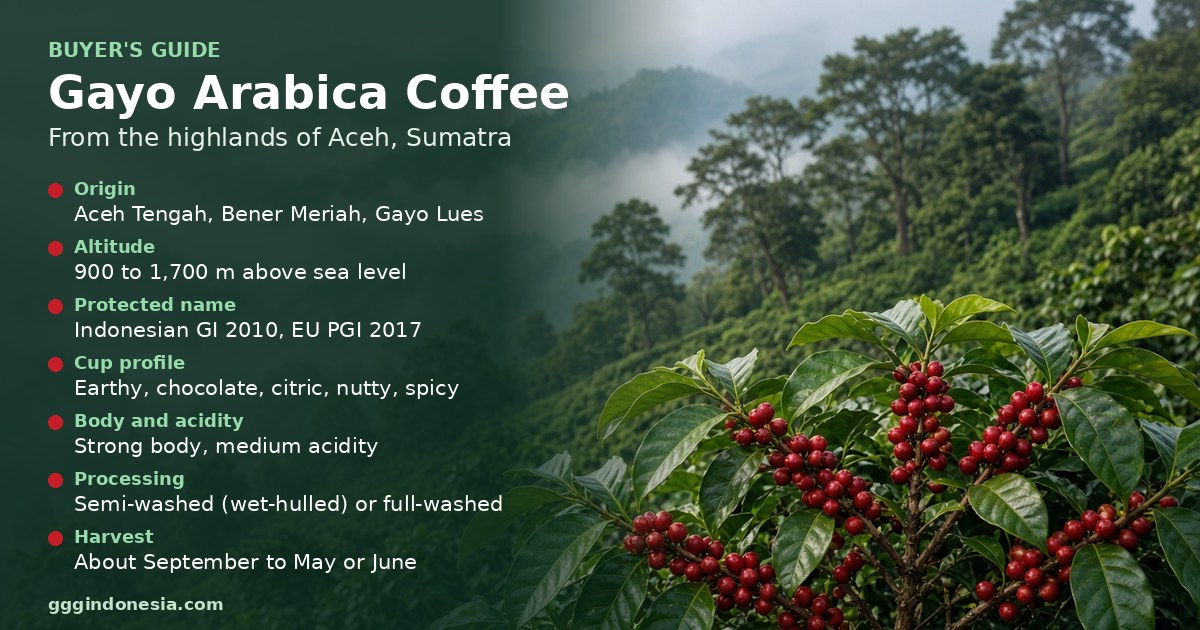
Gayo Arabica Coffee: A Buyer's Guide for Importers
18 Oktober 2026
Diterbitkan oleh Admin Utama GGG
Insight GGG
Gayo Arabica is one of the most sought-after coffees from Indonesia. Grown in the highlands of Aceh at the northern tip of Sumatra, it's known for a strong, full body with more brightness than most Sumatran coffees, which makes it a favourite with specialty roasters and blenders alike. PT Gatha Gemilang Global is based in Medan, North Sumatra, the main trading and shipping hub for northern Sumatran coffee. This guide covers where Gayo comes from, how it tastes and is processed, what its protected name means for your labels, and what to check before you order.
General industry background: the Gayo Highlands sit at the northern end of the Bukit Barisan mountain range in Aceh province. According to the official geographical indication specification, Kopi Arabika Gayo is grown in three districts, Aceh Tengah, Bener Meriah and Gayo Lues, at elevations between 900 and 1,700 metres above sea level, with most Arabica planted between 1,000 and 1,400 metres. Most of it is grown by smallholder farmers.
General industry background: Gayo is one of Indonesia's best-protected coffee origins. Kopi Arabika Gayo was registered as a geographical indication in Indonesia in 2010, and in 2017 it was entered in the European Union's register as a Protected Geographical Indication (PGI) under Commission Implementing Regulation (EU) 2017/870.
Under the specification, growing and processing up to the final green bean must take place inside the Gayo Highlands, while roasting can happen anywhere as long as the beans come from the area.
For importers this matters in two ways. First, if you sell in the EU and want to use the Gayo name on your packaging, check the PGI rules that apply to your product and labels. Second, ask your supplier what origin and traceability documents come with each lot, so you can back up the name on your bag.
On our coffee product page, GGG describes Gayo this way:
Tasting notes: earthy, chocolate, citric notes, nutty, herbal, spicy
Body and acidity: strong, robust body, medium acidity
That medium acidity is what sets Gayo apart from its North Sumatran neighbours. On our site, Mandheling and Lintong are listed with low acidity and a full or heavy body, while Gayo adds citric brightness and nutty notes. As a rough guide, Gayo works well in lighter roasts and filter coffee, as a single origin for specialty menus, and as a blend component that brings body without making the cup flat. For a side-by-side look at Mandheling, Lintong and Gayo, see our Mandheling buyer's guide: https://gggindonesia.com/blog/sumatra-mandheling-coffee-buyer-guide
GGG lists its Indonesian Arabica as full-washed or semi-washed.
General industry background: the Gayo geographical indication covers the typical Sumatran semi-washed method, known as wet-hulling or giling basah, as well as full-washed processing. In wet-hulling, cherries are pulped, fermented and washed, then partly dried, and the parchment is removed while the beans are still moist. The green beans finish drying after hulling. This gives the heavy body and earthy, herbal character Sumatran coffees are known for.
Full-washed Gayo is dried in parchment before hulling and usually cups cleaner and brighter. If you're building a specialty menu around Gayo's citric notes, ask to cup both styles before you decide.
General industry background: the Gayo specification describes a long harvest that runs from about September to May or June, because rain falls through most of the year and the trees flower and fruit almost continuously. It names two peaks, in March and April and in October and November.
In practice, fresh-crop Gayo is available for much of the year. Always confirm the crop year and harvest period of the lot you're quoted.
GGG offers Indonesian Arabica in Grade 1 (Specialty), Grade 2 and Grade 3.
General industry background: Indonesian green coffee is graded under the national standard SNI 01-2907 by counting weighted defects in a 300 gram sample. Grade 1 allows 11 defects or fewer, Grade 2 allows 12 to 25 and Grade 3 allows 26 to 44. Our Robusta buyer's guide explains the defect system in more detail: https://gggindonesia.com/blog/indonesian-robusta-coffee-buyer-guide
These are the checks experienced Gayo buyers usually make:
Moisture content: export green coffee is normally dried to about 12.5% or below, and wet-hulled coffee needs careful final drying.
Defect count: ask for the actual count on a 300 gram sample, not only the grade label.
Screen size: ask for the screen distribution if even roasting matters to you.
Cup test: roast and cup a pre-shipment sample, checking for the citric and chocolate notes you expect and for any musty or fermented flavours.
Origin documents: confirm what traceability information comes with the lot, especially if you plan to use the Gayo name or sell into the EU.
General industry background: Gayo green coffee is commonly packed in 60 kg jute bags, often with hermetic liners to protect it from humidity at sea. Coffee from the Gayo Highlands is usually trucked down to Medan and exported through Belawan port. Green coffee falls under HS code 0901.11. Shipments normally travel with a commercial invoice, packing list, bill of lading, certificate of origin and phytosanitary certificate. EU importers should also check their due-diligence duties under the EU Deforestation Regulation, which covers coffee.
Our team works from Medan, the trading hub for northern Sumatran coffee. We offer Gayo alongside Mandheling, Lintong and Java Arabica, plus Indonesian Robusta. You can see the full range on our coffee product page: https://gggindonesia.com/#arabica
Here's what we can confirm today:
Grades: Grade 1 (Specialty), Grade 2, Grade 3
Processing: full-washed or semi-washed
Payment terms: T/T or irrevocable LC at sight
Samples: available on request
Pricing, volumes and shipping terms are quoted per order. Tell us the grade and process you want, your volume and your destination port, and we'll come back with what we can supply. For background on other Indonesian Arabica regions, read our overview: https://gggindonesia.com/blog/indonesia-arabica
Where is Gayo coffee grown?
In the Gayo Highlands of Aceh, Sumatra. The geographical indication covers the districts of Aceh Tengah, Bener Meriah and Gayo Lues, at 900 to 1,700 metres above sea level.
How is Gayo different from Mandheling?
Both are full-bodied Sumatran Arabicas, but on our site Gayo is listed with medium acidity and citric, nutty notes, while Mandheling is listed with low acidity and a syrupy body with a sweet finish.
Is Gayo coffee a protected origin?
Yes. Kopi Arabika Gayo is a registered geographical indication in Indonesia and a Protected Geographical Indication in the EU.
When is the Gayo harvest?
The official specification gives a harvest from about September to May or June, with peaks in March and April and in October and November.
Can I get a sample before ordering?
Yes. Samples are available on request so you can cup the coffee before you commit.
Whether you need a Grade 1 Gayo for a specialty menu or a semi-washed lot for your house blend, we can help you compare options and arrange samples.
Contact PT Gatha Gemilang Global at admin@gggindonesia.com or WhatsApp +62 812 6451 588, or use the contact form at https://gggindonesia.com/#contact
Where Gayo Coffee Comes From
General industry background: the Gayo Highlands sit at the northern end of the Bukit Barisan mountain range in Aceh province. According to the official geographical indication specification, Kopi Arabika Gayo is grown in three districts, Aceh Tengah, Bener Meriah and Gayo Lues, at elevations between 900 and 1,700 metres above sea level, with most Arabica planted between 1,000 and 1,400 metres. Most of it is grown by smallholder farmers.
Kopi Arabika Gayo: A Protected Name
General industry background: Gayo is one of Indonesia's best-protected coffee origins. Kopi Arabika Gayo was registered as a geographical indication in Indonesia in 2010, and in 2017 it was entered in the European Union's register as a Protected Geographical Indication (PGI) under Commission Implementing Regulation (EU) 2017/870.
Under the specification, growing and processing up to the final green bean must take place inside the Gayo Highlands, while roasting can happen anywhere as long as the beans come from the area.
For importers this matters in two ways. First, if you sell in the EU and want to use the Gayo name on your packaging, check the PGI rules that apply to your product and labels. Second, ask your supplier what origin and traceability documents come with each lot, so you can back up the name on your bag.
Gayo Tasting Notes and Cup Profile
On our coffee product page, GGG describes Gayo this way:
Tasting notes: earthy, chocolate, citric notes, nutty, herbal, spicy
Body and acidity: strong, robust body, medium acidity
That medium acidity is what sets Gayo apart from its North Sumatran neighbours. On our site, Mandheling and Lintong are listed with low acidity and a full or heavy body, while Gayo adds citric brightness and nutty notes. As a rough guide, Gayo works well in lighter roasts and filter coffee, as a single origin for specialty menus, and as a blend component that brings body without making the cup flat. For a side-by-side look at Mandheling, Lintong and Gayo, see our Mandheling buyer's guide: https://gggindonesia.com/blog/sumatra-mandheling-coffee-buyer-guide
Processing: Semi-Washed and Full-Washed Gayo
GGG lists its Indonesian Arabica as full-washed or semi-washed.
General industry background: the Gayo geographical indication covers the typical Sumatran semi-washed method, known as wet-hulling or giling basah, as well as full-washed processing. In wet-hulling, cherries are pulped, fermented and washed, then partly dried, and the parchment is removed while the beans are still moist. The green beans finish drying after hulling. This gives the heavy body and earthy, herbal character Sumatran coffees are known for.
Full-washed Gayo is dried in parchment before hulling and usually cups cleaner and brighter. If you're building a specialty menu around Gayo's citric notes, ask to cup both styles before you decide.
Harvest Season and Timing Your Order
General industry background: the Gayo specification describes a long harvest that runs from about September to May or June, because rain falls through most of the year and the trees flower and fruit almost continuously. It names two peaks, in March and April and in October and November.
In practice, fresh-crop Gayo is available for much of the year. Always confirm the crop year and harvest period of the lot you're quoted.
Grades and Quality Checks Before You Buy
GGG offers Indonesian Arabica in Grade 1 (Specialty), Grade 2 and Grade 3.
General industry background: Indonesian green coffee is graded under the national standard SNI 01-2907 by counting weighted defects in a 300 gram sample. Grade 1 allows 11 defects or fewer, Grade 2 allows 12 to 25 and Grade 3 allows 26 to 44. Our Robusta buyer's guide explains the defect system in more detail: https://gggindonesia.com/blog/indonesian-robusta-coffee-buyer-guide
These are the checks experienced Gayo buyers usually make:
Moisture content: export green coffee is normally dried to about 12.5% or below, and wet-hulled coffee needs careful final drying.
Defect count: ask for the actual count on a 300 gram sample, not only the grade label.
Screen size: ask for the screen distribution if even roasting matters to you.
Cup test: roast and cup a pre-shipment sample, checking for the citric and chocolate notes you expect and for any musty or fermented flavours.
Origin documents: confirm what traceability information comes with the lot, especially if you plan to use the Gayo name or sell into the EU.
Packing, Shipping and Documents
General industry background: Gayo green coffee is commonly packed in 60 kg jute bags, often with hermetic liners to protect it from humidity at sea. Coffee from the Gayo Highlands is usually trucked down to Medan and exported through Belawan port. Green coffee falls under HS code 0901.11. Shipments normally travel with a commercial invoice, packing list, bill of lading, certificate of origin and phytosanitary certificate. EU importers should also check their due-diligence duties under the EU Deforestation Regulation, which covers coffee.
Sourcing Gayo Arabica with GGG
Our team works from Medan, the trading hub for northern Sumatran coffee. We offer Gayo alongside Mandheling, Lintong and Java Arabica, plus Indonesian Robusta. You can see the full range on our coffee product page: https://gggindonesia.com/#arabica
Here's what we can confirm today:
Grades: Grade 1 (Specialty), Grade 2, Grade 3
Processing: full-washed or semi-washed
Payment terms: T/T or irrevocable LC at sight
Samples: available on request
Pricing, volumes and shipping terms are quoted per order. Tell us the grade and process you want, your volume and your destination port, and we'll come back with what we can supply. For background on other Indonesian Arabica regions, read our overview: https://gggindonesia.com/blog/indonesia-arabica
FAQ
Where is Gayo coffee grown?
In the Gayo Highlands of Aceh, Sumatra. The geographical indication covers the districts of Aceh Tengah, Bener Meriah and Gayo Lues, at 900 to 1,700 metres above sea level.
How is Gayo different from Mandheling?
Both are full-bodied Sumatran Arabicas, but on our site Gayo is listed with medium acidity and citric, nutty notes, while Mandheling is listed with low acidity and a syrupy body with a sweet finish.
Is Gayo coffee a protected origin?
Yes. Kopi Arabika Gayo is a registered geographical indication in Indonesia and a Protected Geographical Indication in the EU.
When is the Gayo harvest?
The official specification gives a harvest from about September to May or June, with peaks in March and April and in October and November.
Can I get a sample before ordering?
Yes. Samples are available on request so you can cup the coffee before you commit.
Request Gayo Arabica Samples and a Quote
Whether you need a Grade 1 Gayo for a specialty menu or a semi-washed lot for your house blend, we can help you compare options and arrange samples.
Contact PT Gatha Gemilang Global at admin@gggindonesia.com or WhatsApp +62 812 6451 588, or use the contact form at https://gggindonesia.com/#contact
A
Author: Admin Utama GGG
Export commodity specialist at PT Gatha Gemilang Global. Focuses on developing international market strategies and supply chain management of superior Indonesian products.