Kembali ke BlogAgriculture 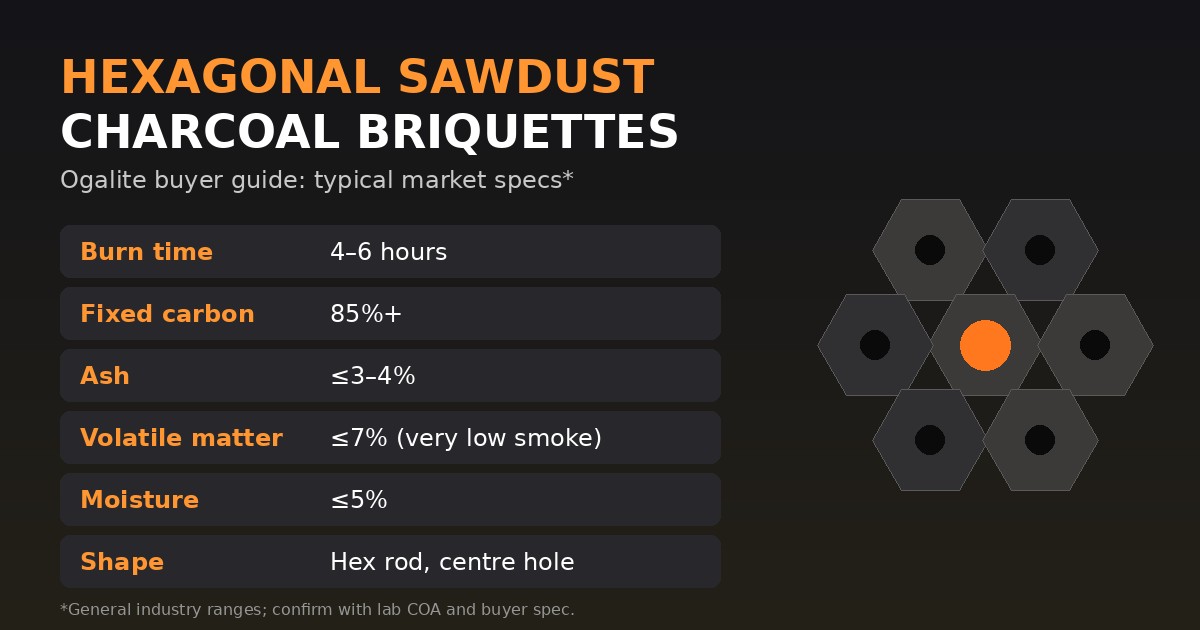
Hexagonal Sawdust Charcoal Briquettes (Ogalite): A Buyer's Guide to Specs, Testing and Shipping
11 Oktober 2026
Diterbitkan oleh Admin Utama GGG
Insight GGG
Hexagonal sawdust charcoal briquettes, often called ogalite or ogatan, are one of the most consistent fuels in the barbecue trade. Korean and Japanese grill restaurants use them for long, even heat at the table, and BBQ importers in the Middle East, China and the EU are adding them next to lump charcoal. This guide explains how they are made, which specs buyers usually ask for, and how to check a supplier before you order.
It is a charcoal log made from compressed hardwood sawdust. The sawdust is pressed under heat into a hexagonal rod with a hole through the centre, then carbonized in a kiln. The lignin in the wood binds the rod, so (as a general industry practice) no chemical binder is needed. The centre hole lets air flow through the log, which helps it light evenly and burn steadily.
Because the raw material is a by-product of sawmills, the shape, density and quality are far more uniform than lump charcoal, where every piece is different.
The figures below are typical claims found in published supplier listings (not GGG lab results). Always confirm them with a lab COA and your own burn test.
Long burn:
Indonesian listings commonly claim about 4 to 6 hours.
Very low smoke:
Volatile matter is usually listed at around 5 to 7%, much lower than typical lump charcoal, so the briquette produces very little smoke once lit.
Low ash:
Listings commonly show ash around 3.6 to 3.9%.
High fixed carbon:
Indonesian listings often claim 87 to 90% fixed carbon, with moisture around 3 to 4.5% and calorific value around 6,900 to 7,100 kcal/kg.
Uniform size:
Every piece is the same length and diameter, which makes heat easy to control and packing easy to plan.
For Korean yakiniku and Japanese BBQ use, the market spec seen in trade practice is roughly:
Fixed carbon: 85% or higher
Ash: 3 to 4% or lower
Moisture: 5% or lower
Volatile matter: 7% or lower
Calorific value: 7,000 kcal/kg or higher
Burn time: 4 to 6 hours or more
Shape: hexagonal, about 35 to 40 mm diameter, length 10 to 40 cm, centre hole about 8 to 10 mm
Packing: typically 10 kg cartons with an inner plastic bag
Buyers also commonly ask for no chemical additives, low sulfur (often 0.05 to 0.07% or lower), white or cream-coloured ash, a COA for each lot, an MSDS, and photos or video before loading. Treat these as general industry ranges and confirm the exact spec sheet with your buyer.
Indonesian ogalite is commonly made from hardwood sawdust such as merbau and mahogany. The wood species affects density, burn time and ash colour, so ask your supplier which sawdust is used and keep it consistent across shipments.
Legality matters too. Some timber species are restricted (for example, sonokeling is listed under CITES Appendix II), and EU, Japanese and Korean buyers increasingly ask for proof that the raw material is legal. Ask for supplier legality documents such as SVLK/S-LK or a supplier declaration, and avoid any material of unclear origin. GGG does not handle mangrove wood.
1. Lab analysis:
Send a sample to an independent lab for fixed carbon, ash, moisture, volatile matter and calorific value. Indonesian labs such as Sucofindo or Geoservices are commonly used.
2. Burn test:
Light a few pieces and time them. Check that there is no spark, no strong smell and that the ash is light in colour.
3. Drop and break test:
Good briquettes are dense and do not crumble when dropped. Too many broken pieces mean weak pressing or poor packing.
4. Size check:
Measure diameter, length and hole size against your spec. Ask for a cap on broken pieces and fines.
5. Pre-loading photos or video:
Ask for images of the cartons and the stuffing of the container.
HS code:
Wood charcoal other than bamboo is generally classified under HS 4402.90. Confirm the code with your customs broker.
Dangerous goods:
Charcoal is generally shipped as IMDG UN1361, Class 4.2 (self-heating). Under the latest IMDG amendments, the charcoal must be weathered or cooled before packing, and stowage rules apply, such as free space above the cargo and limits on stack height. Not every carrier accepts it, and a DG surcharge can apply, so check with your forwarder early.
Container load:
Trade practice puts a 40HC at roughly 25 to 27 tonnes of ogalite, depending on the carrier's payload limit and carton size.
Documents:
Commercial invoice, packing list, bill of lading, Certificate of Origin (Form E for China, AK for Korea or AJCEP for Japan where preferential tariffs apply), COA, MSDS and fumigation if your market requires it.
According to 2024 UN Comtrade data, Indonesia is the world's largest exporter of wood charcoal under HS 4402.90. Japan and South Korea are both major charcoal importers, and their grill restaurant markets favour long-burning, low-smoke fuels such as ogalite. Saudi Arabia, Iraq, Lebanon and Turkey are the top destinations for Indonesian charcoal overall, and EU BBQ importers pay attention to legality paperwork.
PT Gatha Gemilang Global ships from Belawan, North Sumatra. We work with Indonesian charcoal producers and can arrange samples and independent lab testing so you can check the product against your own spec before you order. Tell us your target market, spec and packing, and we will come back with what we can supply.
Contact us at admin@gggindonesia.com or WhatsApp +62 812-6451-588.
What is a hexagonal sawdust briquette?
It is a charcoal log made from compressed hardwood sawdust. The sawdust is pressed under heat into a hexagonal rod with a hole through the centre, then carbonized in a kiln. The lignin in the wood binds the rod, so (as a general industry practice) no chemical binder is needed. The centre hole lets air flow through the log, which helps it light evenly and burn steadily.
Because the raw material is a by-product of sawmills, the shape, density and quality are far more uniform than lump charcoal, where every piece is different.
Why grill restaurants like it
The figures below are typical claims found in published supplier listings (not GGG lab results). Always confirm them with a lab COA and your own burn test.
Long burn:
Indonesian listings commonly claim about 4 to 6 hours.
Very low smoke:
Volatile matter is usually listed at around 5 to 7%, much lower than typical lump charcoal, so the briquette produces very little smoke once lit.
Low ash:
Listings commonly show ash around 3.6 to 3.9%.
High fixed carbon:
Indonesian listings often claim 87 to 90% fixed carbon, with moisture around 3 to 4.5% and calorific value around 6,900 to 7,100 kcal/kg.
Uniform size:
Every piece is the same length and diameter, which makes heat easy to control and packing easy to plan.
Specs buyers usually ask for
For Korean yakiniku and Japanese BBQ use, the market spec seen in trade practice is roughly:
Fixed carbon: 85% or higher
Ash: 3 to 4% or lower
Moisture: 5% or lower
Volatile matter: 7% or lower
Calorific value: 7,000 kcal/kg or higher
Burn time: 4 to 6 hours or more
Shape: hexagonal, about 35 to 40 mm diameter, length 10 to 40 cm, centre hole about 8 to 10 mm
Packing: typically 10 kg cartons with an inner plastic bag
Buyers also commonly ask for no chemical additives, low sulfur (often 0.05 to 0.07% or lower), white or cream-coloured ash, a COA for each lot, an MSDS, and photos or video before loading. Treat these as general industry ranges and confirm the exact spec sheet with your buyer.
Which wood goes into it?
Indonesian ogalite is commonly made from hardwood sawdust such as merbau and mahogany. The wood species affects density, burn time and ash colour, so ask your supplier which sawdust is used and keep it consistent across shipments.
Legality matters too. Some timber species are restricted (for example, sonokeling is listed under CITES Appendix II), and EU, Japanese and Korean buyers increasingly ask for proof that the raw material is legal. Ask for supplier legality documents such as SVLK/S-LK or a supplier declaration, and avoid any material of unclear origin. GGG does not handle mangrove wood.
Quality checks before you order
1. Lab analysis:
Send a sample to an independent lab for fixed carbon, ash, moisture, volatile matter and calorific value. Indonesian labs such as Sucofindo or Geoservices are commonly used.
2. Burn test:
Light a few pieces and time them. Check that there is no spark, no strong smell and that the ash is light in colour.
3. Drop and break test:
Good briquettes are dense and do not crumble when dropped. Too many broken pieces mean weak pressing or poor packing.
4. Size check:
Measure diameter, length and hole size against your spec. Ask for a cap on broken pieces and fines.
5. Pre-loading photos or video:
Ask for images of the cartons and the stuffing of the container.
Shipping: what importers should know
HS code:
Wood charcoal other than bamboo is generally classified under HS 4402.90. Confirm the code with your customs broker.
Dangerous goods:
Charcoal is generally shipped as IMDG UN1361, Class 4.2 (self-heating). Under the latest IMDG amendments, the charcoal must be weathered or cooled before packing, and stowage rules apply, such as free space above the cargo and limits on stack height. Not every carrier accepts it, and a DG surcharge can apply, so check with your forwarder early.
Container load:
Trade practice puts a 40HC at roughly 25 to 27 tonnes of ogalite, depending on the carrier's payload limit and carton size.
Documents:
Commercial invoice, packing list, bill of lading, Certificate of Origin (Form E for China, AK for Korea or AJCEP for Japan where preferential tariffs apply), COA, MSDS and fumigation if your market requires it.
Where it sells
According to 2024 UN Comtrade data, Indonesia is the world's largest exporter of wood charcoal under HS 4402.90. Japan and South Korea are both major charcoal importers, and their grill restaurant markets favour long-burning, low-smoke fuels such as ogalite. Saudi Arabia, Iraq, Lebanon and Turkey are the top destinations for Indonesian charcoal overall, and EU BBQ importers pay attention to legality paperwork.
Sourcing hexagonal briquettes with GGG
PT Gatha Gemilang Global ships from Belawan, North Sumatra. We work with Indonesian charcoal producers and can arrange samples and independent lab testing so you can check the product against your own spec before you order. Tell us your target market, spec and packing, and we will come back with what we can supply.
Contact us at admin@gggindonesia.com or WhatsApp +62 812-6451-588.
A
Author: Admin Utama GGG
Export commodity specialist at PT Gatha Gemilang Global. Focuses on developing international market strategies and supply chain management of superior Indonesian products.