Kembali ke BlogAgriculture 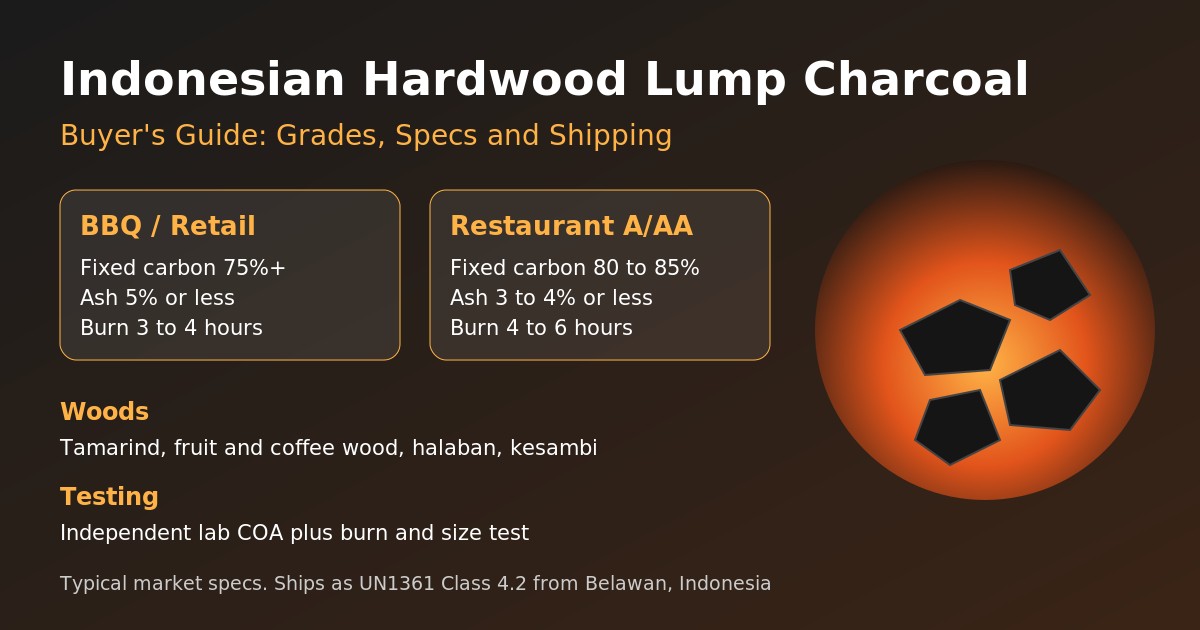
Indonesian Hardwood Lump Charcoal: A Buyer's Guide to Grades, Specs and Shipping
12 Oktober 2026
Diterbitkan oleh Admin Utama GGG
Insight GGG
Hardwood lump charcoal is the workhorse fuel of restaurant grills, shisha lounges and BBQ retail shelves. Indonesia is one of the largest exporters of wood charcoal in the world, and buyers from Saudi Arabia to Korea come back for the same reasons: long burn, low ash and very little smoke. This guide explains the grades, the specs buyers usually ask for, how to test a lot, and what to know about shipping from Belawan.
According to 2024 UN Comtrade data (via World Bank WITS), Indonesia was the largest exporter of wood charcoal under HS 4402.90, shipping about 559 thousand tonnes worth USD 351 million. Its main destinations were Saudi Arabia, Iraq, Malaysia, Lebanon and Turkey, while Japan and South Korea are major importers of premium charcoal.
The dense tropical hardwoods used for export charcoal produce lumps that burn hotter and longer than softwood charcoal. Much of the raw wood comes from orchard and plantation renewal (fruit wood, coffee wood, tamarind), which makes the origin of the material easier to document.
Tamarind (asam jawa)
A classic restaurant-grade wood: dense lumps, steady heat and low smoke.
Fruit wood and coffee wood
Rambutan, guava and coffee wood from orchard renewal. These are widely used in export listings and are easy to trace back to the farm.
Halaban (laban, Vitex pinnata)
A traditional Indonesian export charcoal. Market listings typically quote 3 to 4 hours of burn time.
Kesambi (Schleichera oleosa)
A very heavy hardwood from the dry forests of East Java, NTB and NTT, used mainly for white charcoal (binchotan style) aimed at Japan and Korea.
GGG does not source or supply mangrove charcoal. We ask our suppliers to confirm that no mangrove wood is used.
The figures below are typical market specifications reported in industry listings, not guaranteed values for a specific lot. Every buyer should confirm them against their own spec sheet and an independent lab report.
BBQ and retail grade (lump)
Fixed carbon of 75% or more, ash of 5% or less, moisture of 8% or less, volatile matter up to 15 to 20%, calorific value from 7,000 kcal/kg, and about 3 to 4 hours of burn. Sizes are typically 3 to 10 cm or 5 to 20 cm.
Restaurant and HORECA grade (A / AA)
Fixed carbon around 80 to 85%, ash of 3 to 4% or less, moisture of 6% or less, volatile matter of 13 to 15% or less, and calorific value from 7,500 kcal/kg. Buyers expect 4 to 6 hours of burn with no sparks, no smoke and minimal fines.
Premium white charcoal (binchotan style)
Industry listings quote fixed carbon of 85 to 90%, ash of 2 to 3% and 6 to 7 hours of burn. Quality varies widely between producers, so sampling is essential.
No chemicals
The charcoal should be pure wood with no added binders or accelerants.
Low sulfur
Many buyers set a limit of around 0.05 to 0.07%.
Clean ash
White or cream ash is a sign of good carbonization.
Lot documents
A certificate of analysis (COA) per lot, an MSDS, and photos or video of the goods before loading.
Ask for a proximate analysis from an independent laboratory covering fixed carbon, ash, moisture, volatile matter and calorific value. Then run a practical burn test: light a measured amount, record the time to full glow, total burn time, sparks, smoke and the colour of the ash. A size check (percentage of fines and undersized pieces) is also worth doing, because fines are a common complaint at destination.
GGG can arrange samples and independent lab testing so you can check the product against your spec before ordering.
Packing
Common formats are PP bags or kraft bags of 5 to 20 kg for retail and BBQ, and 10 to 20 kg PP bags or cartons for restaurant grade. Private-label printing can be discussed per order.
Container load
As a general industry guide, a 40HC container holds roughly 18 to 27 tonnes of lump charcoal depending on wood density, size and packing. Shipping lines may also cap the payload.
Dangerous goods rules
Charcoal is classified as UN1361, Class 4.2 (self-heating) under the IMDG Code. Under the latest amendments, cargo must be declared as dangerous goods, cooled or weathered before packing, packed at no more than 40°C, and stowed with space above the cargo. This adds a DG surcharge and not every carrier accepts it, so it should be confirmed with the forwarder before booking.
Export documents
Commercial invoice, packing list, bill of lading, certificate of origin (including preferential forms where they apply), COA and MSDS, plus fumigation if the buyer requests it. The HS code for wood charcoal other than bamboo is 4402.90.
Middle East (Saudi Arabia, Iraq, Lebanon, Turkey)
The largest volume markets for Indonesian charcoal, mainly BBQ and restaurant lump.
Korea and Japan
Premium markets for yakiniku and gogi-gui grilling, favouring high fixed carbon lump, binchotan-style white charcoal and hexagonal sawdust briquettes.
European Union
BBQ retail demand, where buyers often ask for extra documentation on the legal origin of the wood.
China and Malaysia
Short freight from Belawan, with demand for both grilling and industrial uses.
PT Gatha Gemilang Global ships from Belawan, North Sumatra, and works with buyers on grade, sizing, packing and documents. Send us your target spec and destination port and we will come back with options and sample arrangements.
Contact us at admin@gggindonesia.com or WhatsApp +62 812-6451-588.
Why Indonesian hardwood charcoal
According to 2024 UN Comtrade data (via World Bank WITS), Indonesia was the largest exporter of wood charcoal under HS 4402.90, shipping about 559 thousand tonnes worth USD 351 million. Its main destinations were Saudi Arabia, Iraq, Malaysia, Lebanon and Turkey, while Japan and South Korea are major importers of premium charcoal.
The dense tropical hardwoods used for export charcoal produce lumps that burn hotter and longer than softwood charcoal. Much of the raw wood comes from orchard and plantation renewal (fruit wood, coffee wood, tamarind), which makes the origin of the material easier to document.
Common wood types
Tamarind (asam jawa)
A classic restaurant-grade wood: dense lumps, steady heat and low smoke.
Fruit wood and coffee wood
Rambutan, guava and coffee wood from orchard renewal. These are widely used in export listings and are easy to trace back to the farm.
Halaban (laban, Vitex pinnata)
A traditional Indonesian export charcoal. Market listings typically quote 3 to 4 hours of burn time.
Kesambi (Schleichera oleosa)
A very heavy hardwood from the dry forests of East Java, NTB and NTT, used mainly for white charcoal (binchotan style) aimed at Japan and Korea.
GGG does not source or supply mangrove charcoal. We ask our suppliers to confirm that no mangrove wood is used.
Grades and typical specs
The figures below are typical market specifications reported in industry listings, not guaranteed values for a specific lot. Every buyer should confirm them against their own spec sheet and an independent lab report.
BBQ and retail grade (lump)
Fixed carbon of 75% or more, ash of 5% or less, moisture of 8% or less, volatile matter up to 15 to 20%, calorific value from 7,000 kcal/kg, and about 3 to 4 hours of burn. Sizes are typically 3 to 10 cm or 5 to 20 cm.
Restaurant and HORECA grade (A / AA)
Fixed carbon around 80 to 85%, ash of 3 to 4% or less, moisture of 6% or less, volatile matter of 13 to 15% or less, and calorific value from 7,500 kcal/kg. Buyers expect 4 to 6 hours of burn with no sparks, no smoke and minimal fines.
Premium white charcoal (binchotan style)
Industry listings quote fixed carbon of 85 to 90%, ash of 2 to 3% and 6 to 7 hours of burn. Quality varies widely between producers, so sampling is essential.
What buyers ask for beyond the numbers
No chemicals
The charcoal should be pure wood with no added binders or accelerants.
Low sulfur
Many buyers set a limit of around 0.05 to 0.07%.
Clean ash
White or cream ash is a sign of good carbonization.
Lot documents
A certificate of analysis (COA) per lot, an MSDS, and photos or video of the goods before loading.
How to test a lot
Ask for a proximate analysis from an independent laboratory covering fixed carbon, ash, moisture, volatile matter and calorific value. Then run a practical burn test: light a measured amount, record the time to full glow, total burn time, sparks, smoke and the colour of the ash. A size check (percentage of fines and undersized pieces) is also worth doing, because fines are a common complaint at destination.
GGG can arrange samples and independent lab testing so you can check the product against your spec before ordering.
Packing and shipping
Packing
Common formats are PP bags or kraft bags of 5 to 20 kg for retail and BBQ, and 10 to 20 kg PP bags or cartons for restaurant grade. Private-label printing can be discussed per order.
Container load
As a general industry guide, a 40HC container holds roughly 18 to 27 tonnes of lump charcoal depending on wood density, size and packing. Shipping lines may also cap the payload.
Dangerous goods rules
Charcoal is classified as UN1361, Class 4.2 (self-heating) under the IMDG Code. Under the latest amendments, cargo must be declared as dangerous goods, cooled or weathered before packing, packed at no more than 40°C, and stowed with space above the cargo. This adds a DG surcharge and not every carrier accepts it, so it should be confirmed with the forwarder before booking.
Export documents
Commercial invoice, packing list, bill of lading, certificate of origin (including preferential forms where they apply), COA and MSDS, plus fumigation if the buyer requests it. The HS code for wood charcoal other than bamboo is 4402.90.
Which markets buy which grade
Middle East (Saudi Arabia, Iraq, Lebanon, Turkey)
The largest volume markets for Indonesian charcoal, mainly BBQ and restaurant lump.
Korea and Japan
Premium markets for yakiniku and gogi-gui grilling, favouring high fixed carbon lump, binchotan-style white charcoal and hexagonal sawdust briquettes.
European Union
BBQ retail demand, where buyers often ask for extra documentation on the legal origin of the wood.
China and Malaysia
Short freight from Belawan, with demand for both grilling and industrial uses.
Work with GGG
PT Gatha Gemilang Global ships from Belawan, North Sumatra, and works with buyers on grade, sizing, packing and documents. Send us your target spec and destination port and we will come back with options and sample arrangements.
Contact us at admin@gggindonesia.com or WhatsApp +62 812-6451-588.
A
Author: Admin Utama GGG
Export commodity specialist at PT Gatha Gemilang Global. Focuses on developing international market strategies and supply chain management of superior Indonesian products.