Kembali ke BlogCoconut 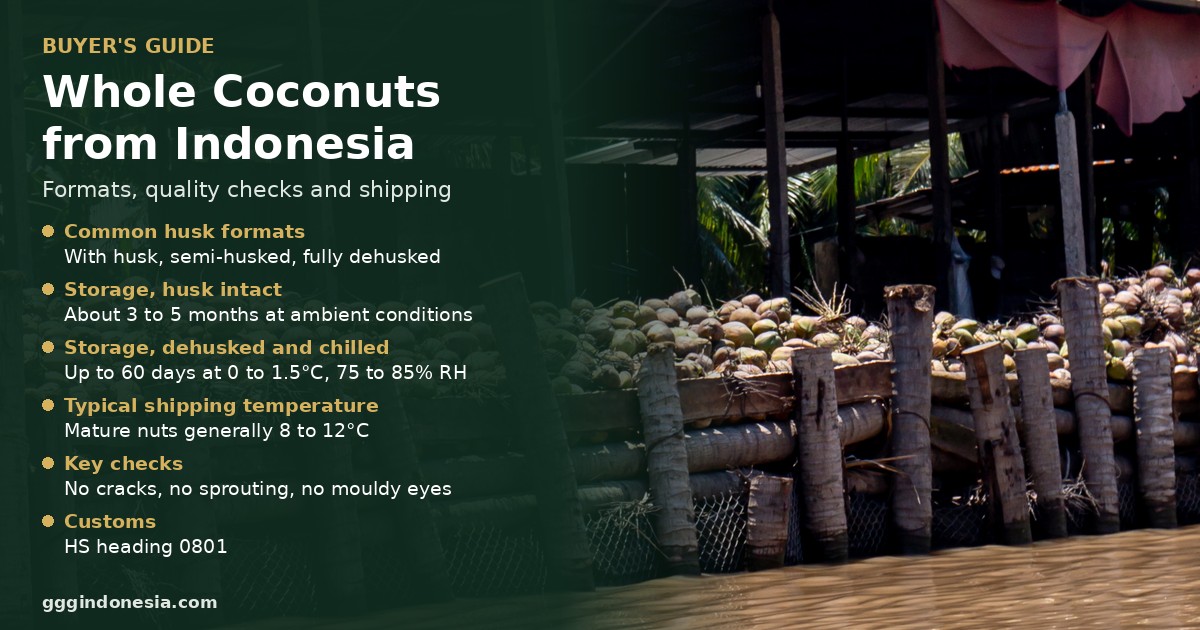
Indonesian Whole Coconuts: A Buyer's Guide for Importers
19 Oktober 2026
Diterbitkan oleh Admin Utama GGG
Insight GGG
Whole coconuts are one of the simplest coconut products to trade and one of the easiest to get wrong. A container of mature coconuts can arrive in perfect condition, or cracked, sprouting and mouldy, depending on the husk format you choose, how the nuts are selected and how they travel. PT Gatha Gemilang Global is an Indonesian exporter based in Medan, North Sumatra, and whole coconut is listed alongside copra on our coconut product page. This guide explains the formats buyers ask for, the quality checks worth agreeing in writing, and what to know about storage, packing and documents before you order.
General industry background: Indonesia is one of the world's largest coconut producers and ranked first in FAOSTAT's 2023 production data, with India and the Philippines also among the top three. Indonesia's quarantine agency notes that most coconut farmers operate small-scale plantations.
Indonesia is also a leading exporter of fresh coconuts. According to the Observatory of Economic Complexity, Indonesia was the largest exporter of coconuts under HS subheading 0801.19 in 2024, with Thailand, Malaysia and the United States the largest importers of that category. Indonesia's quarantine agency has reported coconut exports to more than 100 countries.
General industry background: whole coconuts are traded at two main stages. Mature coconuts, around 11 to 13 months old, have hard white meat and are bought mainly for their flesh. Young coconuts, harvested at about 6 to 9 months, are bought mainly for their water. This guide focuses on mature coconuts, which are commonly traded in three husk formats.
Mature Coconuts with Husk
The full fibrous husk is left on. The husk protects the nut, so this format keeps the longest, but it is the heaviest and bulkiest to ship.
Semi-Husked Coconuts
Most of the husk is removed, but a tuft of fibre is left over the three eyes at the top of the shell. The eyes are the weakest point of the nut, so this tuft helps protect against moisture loss, cracking and mould during transit. The ASEAN Standard for Mature Coconut (ASEAN Stan 56:2018) lists semi-dehusked coconuts as one of its trimmed formats.
Fully Dehusked Coconuts
All of the husk is removed, leaving the hard brown shell. These are lighter and cheaper to ship per nut, but they have the shortest storage life and need the most careful temperature control.
Young green coconuts, often trimmed into a shape, are a separate and more perishable trade with their own ASEAN standard, so they are not covered in this guide.
General industry background: there are no official international grades for fresh coconuts, and informal grades are usually based on size and weight. Under the ASEAN standard, mature coconuts should be whole, free of germination, free of cracks in the shell, sound, clean and able to withstand transport and handling. These are the points experienced buyers usually put in writing:
Maturity: nuts should be fully mature, with hard white meat and a sloshing sound that shows water is still inside.
Size or count: agree a size by count per bag or a minimum weight per nut, because the weight of the nut matters to your customers.
Shell condition: no cracks, no sprouting and no wet, sunken or mouldy eyes.
Husk trim: for semi-husked nuts, agree how much fibre stays over the eyes.
Pre-shipment check: open a representative number of nuts before loading and record flesh and water condition, so you have a baseline if quality is questioned on arrival.
General industry background: husk removal shortens storage life, so the format you choose shapes your logistics. University of Hawaii postharvest guidelines give these figures for mature coconuts:
With husk intact: about 3 to 5 months at ambient conditions.
Dehusked, chilled: up to 60 days at 0 to 1.5°C and 75 to 85% relative humidity.
Dehusked, cool storage: 2 weeks or less at 13 to 16°C and 80 to 85% relative humidity.
The CBI, the Dutch government's import promotion centre, notes that mature coconuts are generally shipped at 8 to 12°C with humidity around 80%, and that sudden temperature changes of 8°C or more can crack husked nuts. Good ventilation helps prevent mould. If you plan a long voyage, discuss the format and container conditions together, because a semi-husked or dehusked nut that suits a short route may not suit a longer one.
General industry background: mature coconuts are commonly packed in jute or woven sacks by count, often 40 or 50 nuts per bag, or in cardboard boxes of 8 to 20 nuts. Fresh coconuts fall under HS heading 0801. Dehusked coconuts still in their brown shell are often classified under 0801.19, but confirm the exact subheading with your customs broker.
Whole coconuts normally travel with a commercial invoice, packing list, bill of lading, certificate of origin and phytosanitary certificate. Some importing countries apply extra plant-health rules, and Indonesia's quarantine agency has said China has specific requirements for fresh young coconuts, so check your market's rules before the first shipment.
On our coconut product page, GGG lists its coconut products as copra and whole coconut, harvested from Indonesia's tropical coasts and processed with strict hygiene standards. You can see the range here: https://gggindonesia.com/#coconut
Our whole coconuts are supplied semi-husked, with a tuft of fibre left over the eyes to protect the nut in transit.
Here's what we can confirm today:
Products: copra and whole coconut
Size: as requested
Packaging: as requested
Samples: available on request
Pricing, volumes and shipping terms are quoted per order. Tell us the maturity, size or count, packing and destination port you need, and we'll come back with what we can supply. If you're buying coconut for oil milling instead, read our copra guide: https://gggindonesia.com/blog/indonesian-copra-buyer-guide
What is a semi-husked coconut?
It is a mature coconut with most of the husk removed and a tuft of fibre left over the eyes. The tuft helps protect the weakest part of the shell during storage and transport.
How long do whole coconuts keep?
According to University of Hawaii guidelines, mature coconuts with the husk intact keep about 3 to 5 months at ambient conditions, while dehusked nuts keep up to 60 days at 0 to 1.5°C.
What HS code is used for whole coconuts?
Fresh coconuts fall under HS heading 0801. Dehusked coconuts in their brown shell are often classified under 0801.19, but confirm the exact code with your customs broker.
Can I choose the size and packing?
Yes. Size and packaging for our coconut products are agreed per order.
Can I get a sample before ordering?
Yes. Samples are available on request so you can check the nuts before you commit.
Whether you're buying whole coconuts for wholesale, retail or processing, tell us what you need and we can arrange samples.
Contact PT Gatha Gemilang Global at admin@gggindonesia.com or WhatsApp +62 812 6451 588, or use the contact form at https://gggindonesia.com/#contact
Why Source Whole Coconuts from Indonesia
General industry background: Indonesia is one of the world's largest coconut producers and ranked first in FAOSTAT's 2023 production data, with India and the Philippines also among the top three. Indonesia's quarantine agency notes that most coconut farmers operate small-scale plantations.
Indonesia is also a leading exporter of fresh coconuts. According to the Observatory of Economic Complexity, Indonesia was the largest exporter of coconuts under HS subheading 0801.19 in 2024, with Thailand, Malaysia and the United States the largest importers of that category. Indonesia's quarantine agency has reported coconut exports to more than 100 countries.
Whole Coconut Formats Buyers Ask For
General industry background: whole coconuts are traded at two main stages. Mature coconuts, around 11 to 13 months old, have hard white meat and are bought mainly for their flesh. Young coconuts, harvested at about 6 to 9 months, are bought mainly for their water. This guide focuses on mature coconuts, which are commonly traded in three husk formats.
Mature Coconuts with Husk
The full fibrous husk is left on. The husk protects the nut, so this format keeps the longest, but it is the heaviest and bulkiest to ship.
Semi-Husked Coconuts
Most of the husk is removed, but a tuft of fibre is left over the three eyes at the top of the shell. The eyes are the weakest point of the nut, so this tuft helps protect against moisture loss, cracking and mould during transit. The ASEAN Standard for Mature Coconut (ASEAN Stan 56:2018) lists semi-dehusked coconuts as one of its trimmed formats.
Fully Dehusked Coconuts
All of the husk is removed, leaving the hard brown shell. These are lighter and cheaper to ship per nut, but they have the shortest storage life and need the most careful temperature control.
Young green coconuts, often trimmed into a shape, are a separate and more perishable trade with their own ASEAN standard, so they are not covered in this guide.
Quality Checks to Agree Before You Order
General industry background: there are no official international grades for fresh coconuts, and informal grades are usually based on size and weight. Under the ASEAN standard, mature coconuts should be whole, free of germination, free of cracks in the shell, sound, clean and able to withstand transport and handling. These are the points experienced buyers usually put in writing:
Maturity: nuts should be fully mature, with hard white meat and a sloshing sound that shows water is still inside.
Size or count: agree a size by count per bag or a minimum weight per nut, because the weight of the nut matters to your customers.
Shell condition: no cracks, no sprouting and no wet, sunken or mouldy eyes.
Husk trim: for semi-husked nuts, agree how much fibre stays over the eyes.
Pre-shipment check: open a representative number of nuts before loading and record flesh and water condition, so you have a baseline if quality is questioned on arrival.
Storage Life and Shipping Temperatures
General industry background: husk removal shortens storage life, so the format you choose shapes your logistics. University of Hawaii postharvest guidelines give these figures for mature coconuts:
With husk intact: about 3 to 5 months at ambient conditions.
Dehusked, chilled: up to 60 days at 0 to 1.5°C and 75 to 85% relative humidity.
Dehusked, cool storage: 2 weeks or less at 13 to 16°C and 80 to 85% relative humidity.
The CBI, the Dutch government's import promotion centre, notes that mature coconuts are generally shipped at 8 to 12°C with humidity around 80%, and that sudden temperature changes of 8°C or more can crack husked nuts. Good ventilation helps prevent mould. If you plan a long voyage, discuss the format and container conditions together, because a semi-husked or dehusked nut that suits a short route may not suit a longer one.
Packing, HS Code and Documents
General industry background: mature coconuts are commonly packed in jute or woven sacks by count, often 40 or 50 nuts per bag, or in cardboard boxes of 8 to 20 nuts. Fresh coconuts fall under HS heading 0801. Dehusked coconuts still in their brown shell are often classified under 0801.19, but confirm the exact subheading with your customs broker.
Whole coconuts normally travel with a commercial invoice, packing list, bill of lading, certificate of origin and phytosanitary certificate. Some importing countries apply extra plant-health rules, and Indonesia's quarantine agency has said China has specific requirements for fresh young coconuts, so check your market's rules before the first shipment.
Sourcing Whole Coconuts with GGG
On our coconut product page, GGG lists its coconut products as copra and whole coconut, harvested from Indonesia's tropical coasts and processed with strict hygiene standards. You can see the range here: https://gggindonesia.com/#coconut
Our whole coconuts are supplied semi-husked, with a tuft of fibre left over the eyes to protect the nut in transit.
Here's what we can confirm today:
Products: copra and whole coconut
Size: as requested
Packaging: as requested
Samples: available on request
Pricing, volumes and shipping terms are quoted per order. Tell us the maturity, size or count, packing and destination port you need, and we'll come back with what we can supply. If you're buying coconut for oil milling instead, read our copra guide: https://gggindonesia.com/blog/indonesian-copra-buyer-guide
FAQ
What is a semi-husked coconut?
It is a mature coconut with most of the husk removed and a tuft of fibre left over the eyes. The tuft helps protect the weakest part of the shell during storage and transport.
How long do whole coconuts keep?
According to University of Hawaii guidelines, mature coconuts with the husk intact keep about 3 to 5 months at ambient conditions, while dehusked nuts keep up to 60 days at 0 to 1.5°C.
What HS code is used for whole coconuts?
Fresh coconuts fall under HS heading 0801. Dehusked coconuts in their brown shell are often classified under 0801.19, but confirm the exact code with your customs broker.
Can I choose the size and packing?
Yes. Size and packaging for our coconut products are agreed per order.
Can I get a sample before ordering?
Yes. Samples are available on request so you can check the nuts before you commit.
Request Whole Coconut Samples and a Quote
Whether you're buying whole coconuts for wholesale, retail or processing, tell us what you need and we can arrange samples.
Contact PT Gatha Gemilang Global at admin@gggindonesia.com or WhatsApp +62 812 6451 588, or use the contact form at https://gggindonesia.com/#contact
A
Author: Admin Utama GGG
Export commodity specialist at PT Gatha Gemilang Global. Focuses on developing international market strategies and supply chain management of superior Indonesian products.